Carbonated filling machines
Counter-pressure and isobaric filling machines for soda, sparkling drinks, beer and RTD products. Plan temperature, CO₂, cans, bottles and closing.
See options
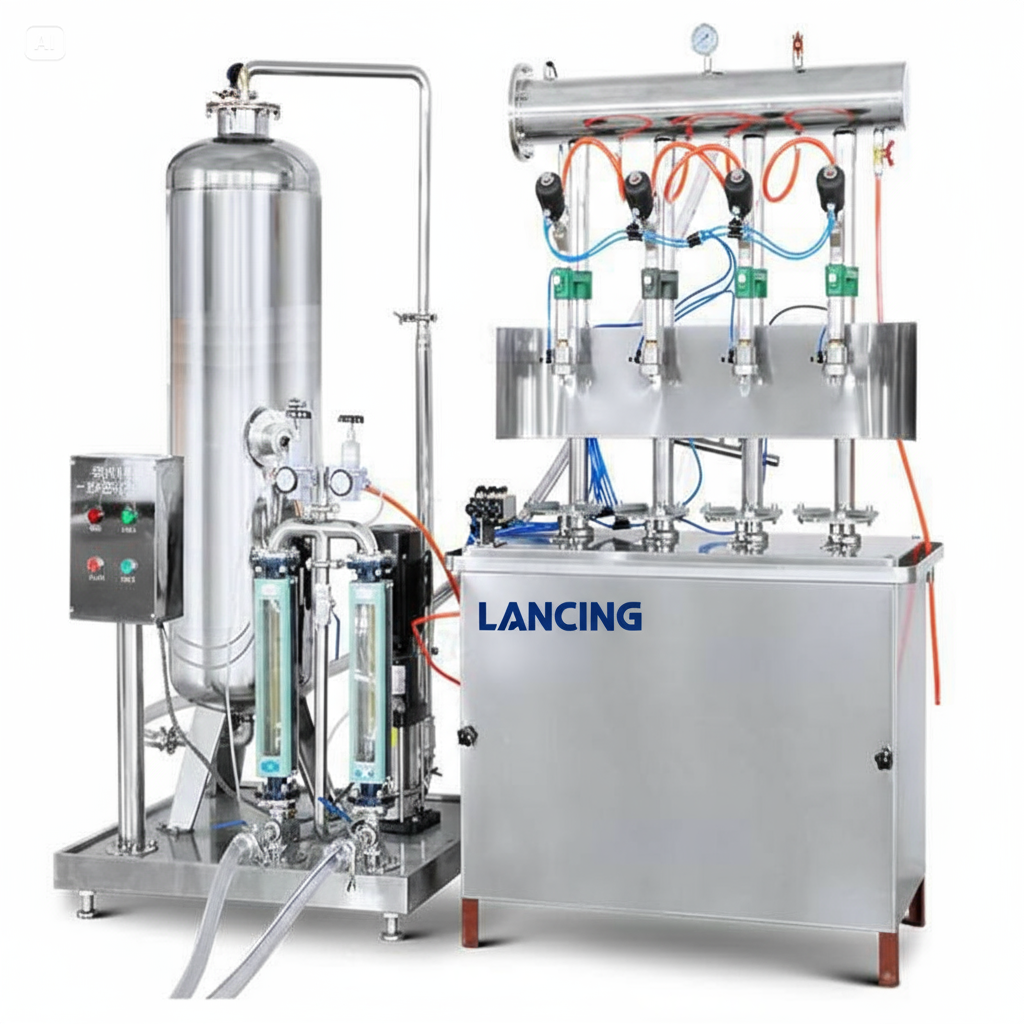
Model LUCF4A
The LUCF4A is a compact four-head counter-pressure filling route for carbonated drinks in cans. It is supplied with a mixing/carbonation module and is intended for pilot, craft and small-to-mid-scale production where dissolved gas needs to be retained during filling.
Published figures are application-dependent reference data and must be confirmed during specification or product trials.
Typical duties
Machine format
Reference specification
| Model | LUCF4A |
|---|---|
| Filling heads | 4 |
| Indicative capacity | 240–400 cans/hour |
| Reference can formats | 330–500 ml |
| Filling pressure | Approx. 0.2–0.3 MPa |
| Air supply | Approx. 0.5–0.7 MPa |
Selection note
Carbonation level, liquid temperature, can dimensions, seam/end specification and upstream chilling all affect results. Confirm the complete beverage process and downstream can-closing route rather than specifying the filler in isolation.
Prepare the project dataRelated machine families
Counter-pressure and isobaric filling machines for soda, sparkling drinks, beer and RTD products. Plan temperature, CO₂, cans, bottles and closing.
See optionsSemi-automatic filling machines for liquids, pastes, powders and larger containers. Compare operator workflow, output, changeover and upgrade paths.
See optionsFood and beverage filling machinery for oils, sauces, honey, powders, granules, still drinks and carbonated products. Plan hygiene and line integration.
See optionsQuick answers
The machine is normally shortlisted for soda and sparkling soft drinks, seltzer and carbonated water, ready-to-drink cocktails. Final suitability depends on product behaviour, materials compatibility, fill range and the intended container.
No. Published figures are reference conditions. Real throughput depends on product viscosity or flow, dose size, container handling, operator workflow, changeovers and downstream equipment.
Integration can be assessed with conveyors, container handling, capping, labelling, coding, sealing and accumulation. The control and layout scope should be agreed before order.
Send the product data, fill volumes, container samples or drawings, target output, utilities, cleaning method, available footprint and details of any upstream or downstream machinery.
Ready to discuss your application?
Tell us what you fill, your fill range, container and target output. We will help you narrow the practical machine options before quotation.
Application verification
Counter-pressure or isobaric filling depends on the prepared beverage, gas condition, can, operating sequence and closure timing. Use the actual product and production process; a water demonstration cannot prove carbonation retention or foam behaviour.
| Verification area | Evidence to collect | Decision supported |
|---|---|---|
| Beverage condition | Temperature, carbonation/process condition, storage and transfer to the filler. | Operating window and product-feed requirements. |
| Can format | Production cans, opening, stability, dimensional variation and fill level/headspace. | Format parts and handling method. |
| Pressure/fill sequence | Purge or pressurisation steps within the selected machine scope, fill, vent and release behaviour. | Recipe and acceptable foam/product loss. |
| Operator cycle | Can loading/removal, controls, spill handling and transfer to seaming. | Sustainable output and ergonomic work cell. |
| Closure timing | Time and movement from fill to seamer plus interrupted-pack treatment. | Line layout and finished-pack quality. |
Use the trial guide and semi-automatic work-cell guidance. Product-process and food-safety limits must come from the buyer’s validated beverage process and competent technical controls.