Pump filling machines
Compare gear, rotor, magnetic, diaphragm and other pump filling machines for oils, detergents, sauces, gels and compatible chemical products.
See options
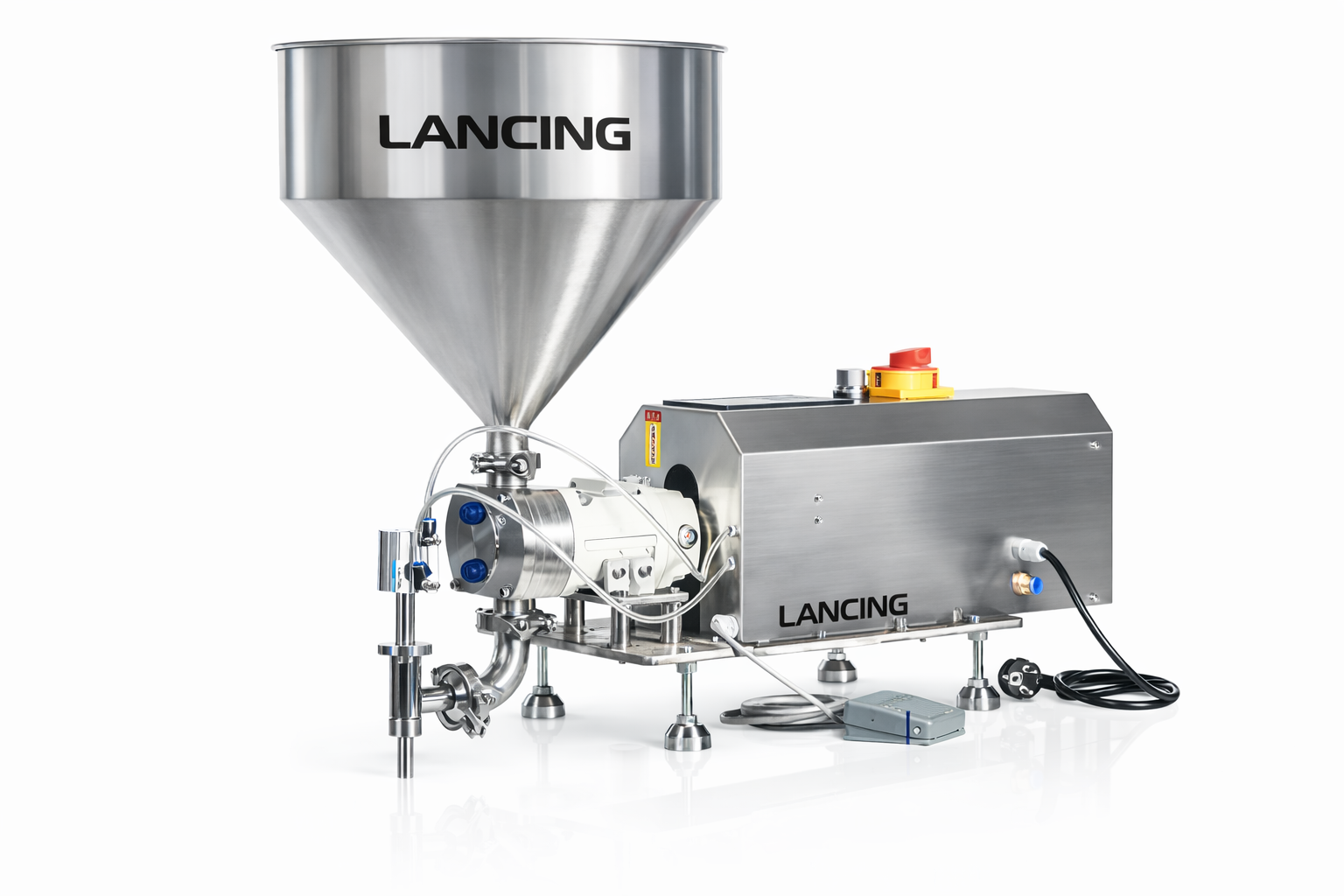
Model LU-RPGT900 / LU-RPG900
This compact rotor-pump filling machine is intended for thick products and selected recipes containing particles. A hopper feeds the positive-displacement pump, giving a practical semi-automatic route for jars, bottles and tubs when an operator-led workstation is preferred.
Published figures are application-dependent reference data and must be confirmed during specification or product trials.
Typical duties
Machine format
Reference specification
| Model | LU-RPG900 / LU-RPGT900 |
|---|---|
| Filling range | 5–5000 ml |
| Indicative speed | 10–60 bottles/min based on 250 ml jam |
| Indicative accuracy | ±1%, application dependent |
| Power | 750 W |
| Hopper | 30 L |
Selection note
Particle size, product shear sensitivity and cleaning method are important. The stated speed depends strongly on dose size, operator handling, nozzle position and product flow, so a timed product trial should be used for capacity planning.
Prepare the project dataRelated machine families
Compare gear, rotor, magnetic, diaphragm and other pump filling machines for oils, detergents, sauces, gels and compatible chemical products.
See optionsCompare piston, servo and rotor-pump paste filling machines for sauces, honey, creams, gels, adhesives and other viscous products in the UK.
See optionsSemi-automatic filling machines for liquids, pastes, powders and larger containers. Compare operator workflow, output, changeover and upgrade paths.
See optionsQuick answers
The machine is normally shortlisted for jam and fruit preparations, tomato paste and sauces, honey, gels and viscous liquids. Final suitability depends on product behaviour, materials compatibility, fill range and the intended container.
No. Published figures are reference conditions. Real throughput depends on product viscosity or flow, dose size, container handling, operator workflow, changeovers and downstream equipment.
Integration can be assessed with conveyors, container handling, capping, labelling, coding, sealing and accumulation. The control and layout scope should be agreed before order.
Send the product data, fill volumes, container samples or drawings, target output, utilities, cleaning method, available footprint and details of any upstream or downstream machinery.
Ready to discuss your application?
Tell us what you fill, your fill range, container and target output. We will help you narrow the practical machine options before quotation.
Application verification
Rotor-pump paste filling should be tested with the most difficult representative viscosity and particle condition. The product path, pump response, feed and nozzle must be considered together rather than treating the pump name as proof of suitability.
| Trial focus | Evidence to collect | Decision supported |
|---|---|---|
| Product structure | Particles, fibres, shear response, settling and temperature. | Pump, passages, speed and product-preparation boundary. |
| Priming and refill | Hopper/source level, air, pauses and recovery after refill. | Stable normal operation and operator method. |
| Dose range | Results at minimum, normal and maximum quantity under stated conditions. | Machine range and required settings/tooling. |
| Cut-off | Strings, drips, suck-back, nozzle height and pack cleanliness. | Nozzle/valve configuration and fill profile. |
| Clean-down | Recovery, pump and hose residue, dismantling and verification. | Changeover labour and approved cleaning sequence. |
Compare the route with piston filling through the technology comparison. Carry approved trial conditions into the quotation and acceptance plan.