Auger filling machines
Auger filling machines for powders in jars, bottles, tubs, bags and pouches. Compare screw tooling, feeders, dust control, accuracy and automation.
See options
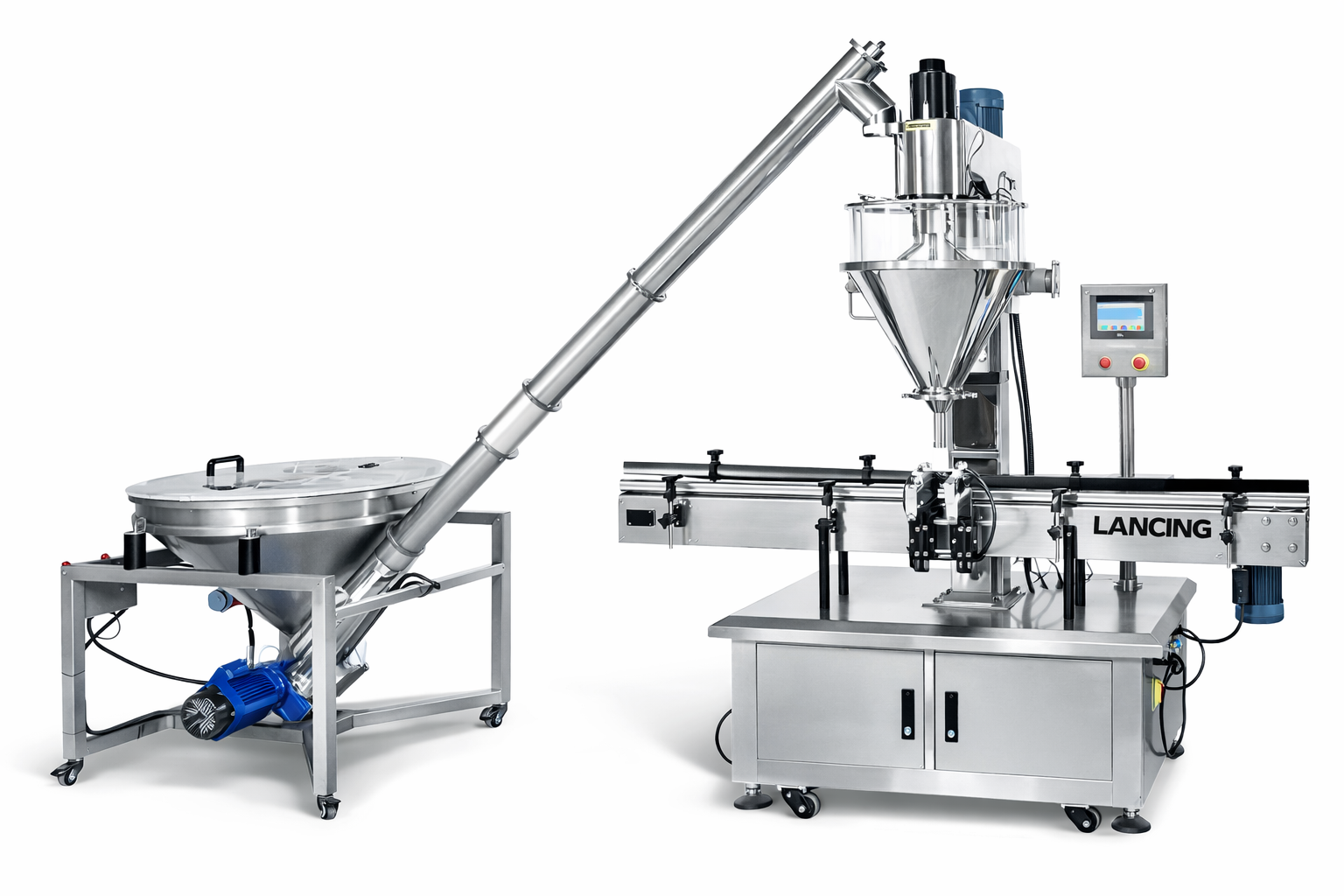
Model LU-FM5A
The LU-FM5A is an automatic servo auger filler supplied with a feeder for controlled powder transfer into the dosing hopper. Auger systems are commonly shortlisted for fine or non-free-flowing powders where a repeatable screw rotation can meter product into jars, bottles or tubs.
Published figures are application-dependent reference data and must be confirmed during specification or product trials.
Typical duties
Machine format
Reference specification
| Reference fill range | 10–500 g |
|---|---|
| Indicative output | 5–20 jars/min |
| Filler power | 2.2 kW |
| Feeder power | 1.1 kW |
| Feeder hopper | 150 L |
| Reference machine size | Approx. 2000 × 1000 × 1980 mm |
Selection note
Bulk density, dust, flowability and product aeration affect fill weight and speed. Samples should be tested with the intended screw tooling, hopper agitation, extraction and container opening before final acceptance criteria are agreed.
Prepare the project dataRelated machine families
Auger filling machines for powders in jars, bottles, tubs, bags and pouches. Compare screw tooling, feeders, dust control, accuracy and automation.
See optionsCompare powder filling machines using auger, weigh and dosing systems for food, supplement, cosmetic and chemical powders. UK specification advice.
See optionsAutomatic filling machines for liquid, paste, powder and specialist applications. Compare multi-head fillers, conveyors, controls and line integration.
See optionsQuick answers
The machine is normally shortlisted for food and beverage powders, nutraceutical and supplement powders, cosmetic and chemical powders. Final suitability depends on product behaviour, materials compatibility, fill range and the intended container.
No. Published figures are reference conditions. Real throughput depends on product viscosity or flow, dose size, container handling, operator workflow, changeovers and downstream equipment.
Integration can be assessed with conveyors, container handling, capping, labelling, coding, sealing and accumulation. The control and layout scope should be agreed before order.
Send the product data, fill volumes, container samples or drawings, target output, utilities, cleaning method, available footprint and details of any upstream or downstream machinery.
Ready to discuss your application?
Tell us what you fill, your fill range, container and target output. We will help you narrow the practical machine options before quotation.
Application verification
An auger application should be proved with production-representative powder and the normal replenishment method. Bulk density, compaction, dust and hopper history can change the result even when the formulation name is unchanged.
| Trial focus | Evidence to collect | Decision supported |
|---|---|---|
| Material flow | Bridging, rat-holing, agitation effect and restart after a pause. | Hopper, feeder and operator-intervention requirements. |
| Bulk-density variation | Sequential dose results across refills, batches or preparation conditions. | Whether volumetric auger control remains appropriate. |
| Dust and pack opening | Release at feed, chute/nozzle and sealing area. | Containment, extraction, cleaning and pack support. |
| Dose range | Minimum, normal and maximum quantity with the intended tooling. | Auger/tooling coverage and change requirements. |
| Automatic feed | Replenishment response and hopper level during sustained operation. | Feed capacity and control-state requirements. |
Compare the application with weigh filling where density variation or direct net-weight control is material. Use the product-trial guide to document powder history, measurements and open risks.