
Key decisions
Find where the foam is created before slowing the filler
- Record product preparation, transfer pumps, return lines, agitation and temperature.
- Distinguish entrained air already in the product from foam created at the nozzle.
- Test nozzle position, initial flow, main flow, finish flow and withdrawal as one profile.
- Confirm container opening, headspace, wetting and acceptable settling time.
- Measure sustainable good-pack output including foam control and downstream closure.
Trace air from the bulk process to the nozzle
Observe the product in the source vessel before filling. Mixing, recirculation, high transfer velocity, leaking suction connections, pump selection and falling returns can introduce air. If foam already exists in the hopper, a slower nozzle may reduce disturbance but cannot remove the upstream cause.
Record how long the product rests, whether foam changes through the batch and how refill affects the filler. A controlled bulk feed and stable level may be more effective than repeated recipe adjustments. Include the real transfer arrangement during the product trial.
| Foam observation | Possible process area | Evidence to collect |
|---|---|---|
| Foam visible before dosing | Mixing, recirculation, transfer pump, air leak or falling return. | Bulk-vessel and hopper observations before and after refill. |
| Foam starts at initial flow | Nozzle height, jet impact, high opening flow or small neck. | Slow-motion observation of the first part of the dose. |
| Foam increases as container fills | Nozzle above liquid, turbulence, insufficient immersion or narrow headspace. | Nozzle position and liquid surface through the fill profile. |
| Foam appears after transfer | Slosh, acceleration, warm product or downstream impact. | Filled-pack behaviour from filler to closure. |
| Quantity varies with foam | Entrained gas, density change, incomplete settling or measurement method. | Product condition, density and timed quantity results. |
| Product remains on neck | Overflow, withdrawal timing, stringing or external nozzle wetting. | Pack-cleanliness checks and nozzle cut-off sequence. |
Use a staged fill profile where the application benefits
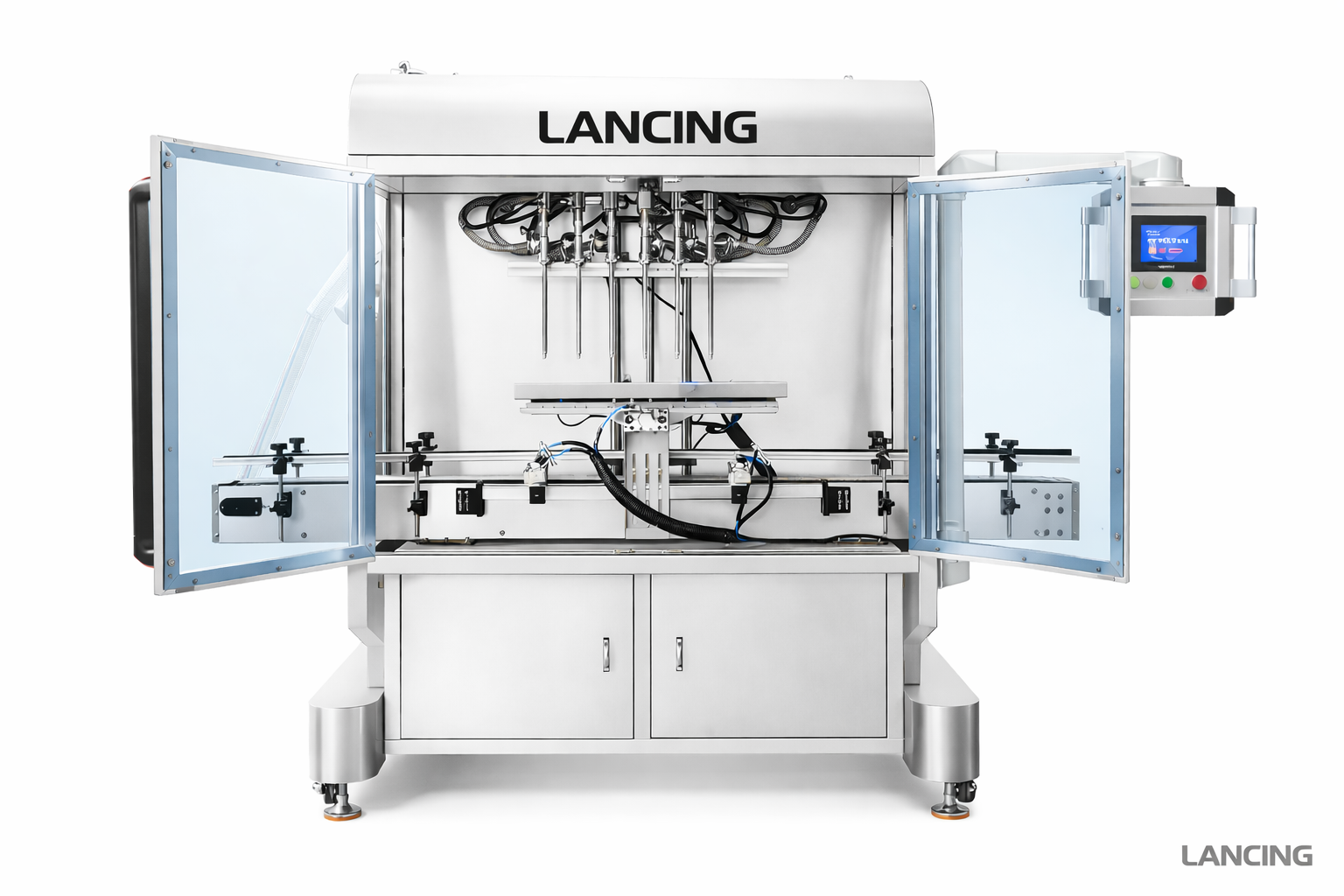
A low initial flow can wet the base or side of the container before the main rate. Filling near or below the rising liquid surface can reduce free-fall impact for suitable products and packs. A controlled finish can protect headspace and cut-off. The required motion depends on nozzle clearance, container stability and product response.
Do not assume bottom-up filling is automatically best. Immersed nozzles may carry product externally, trap air or contact the pack if positioning varies. Test the complete movement and use the nozzle selection guide to compare shut-off and non-contact options.
Treat headspace and settling as pack requirements
Define the acceptable liquid level at filling and at closure. Some foam may settle quickly within the available conveyor distance; other products require a process change or a larger headspace. Check whether closure application, induction sealing, labelling or vision inspection is affected by foam or product on the neck.
Where the pack is sold or controlled by quantity, do not judge only by visible level. Foam and container shape can make level misleading. Use a defined mass or volume method and record when the result is measured relative to filling.
Compare pump, valve and product-path effects
Different feed pumps and valves can shear or aerate a formulation differently. Confirm suction conditions, speed range, recirculation and the effect of product temperature. A pump that transfers the product successfully may still create unacceptable air at the required line rate.
Keep the dosing principle open until the trial has shown the complete route. Review pump filling, piston filling and other relevant methods according to the formulation, dose and cleaning requirement rather than selecting from foam alone.
Prove production output with the closure process connected
A filler can appear successful while containers wait for foam to settle before capping. Measure good closed packs over a representative run, including replenishment and normal stops. Define whether extra conveyor residence, a recipe change or upstream de-aeration is part of the solution.
The line integration guide helps allocate accumulation, closure timing and blocked/starved control. Record the product condition and fill profile used for acceptance so the result can be repeated on site.
Foaming-liquid application data
- Product sample and preparation method.
- Temperature, density and observed air or foam behaviour.
- Bulk vessel, agitation, transfer and refill arrangement.
- Minimum, normal and maximum dose.
- Container opening, headspace, stability and closure timing.
- Acceptable appearance and quantity measurement method.
- Nozzle movement and contact restrictions.
- Required sustained output including settling and closing.