Volumetric filling machines
Compare volumetric filling machines using piston, pump or cup dosing for liquids, pastes, sauces, creams and granules. UK advice from Lancing Ltd.
See options
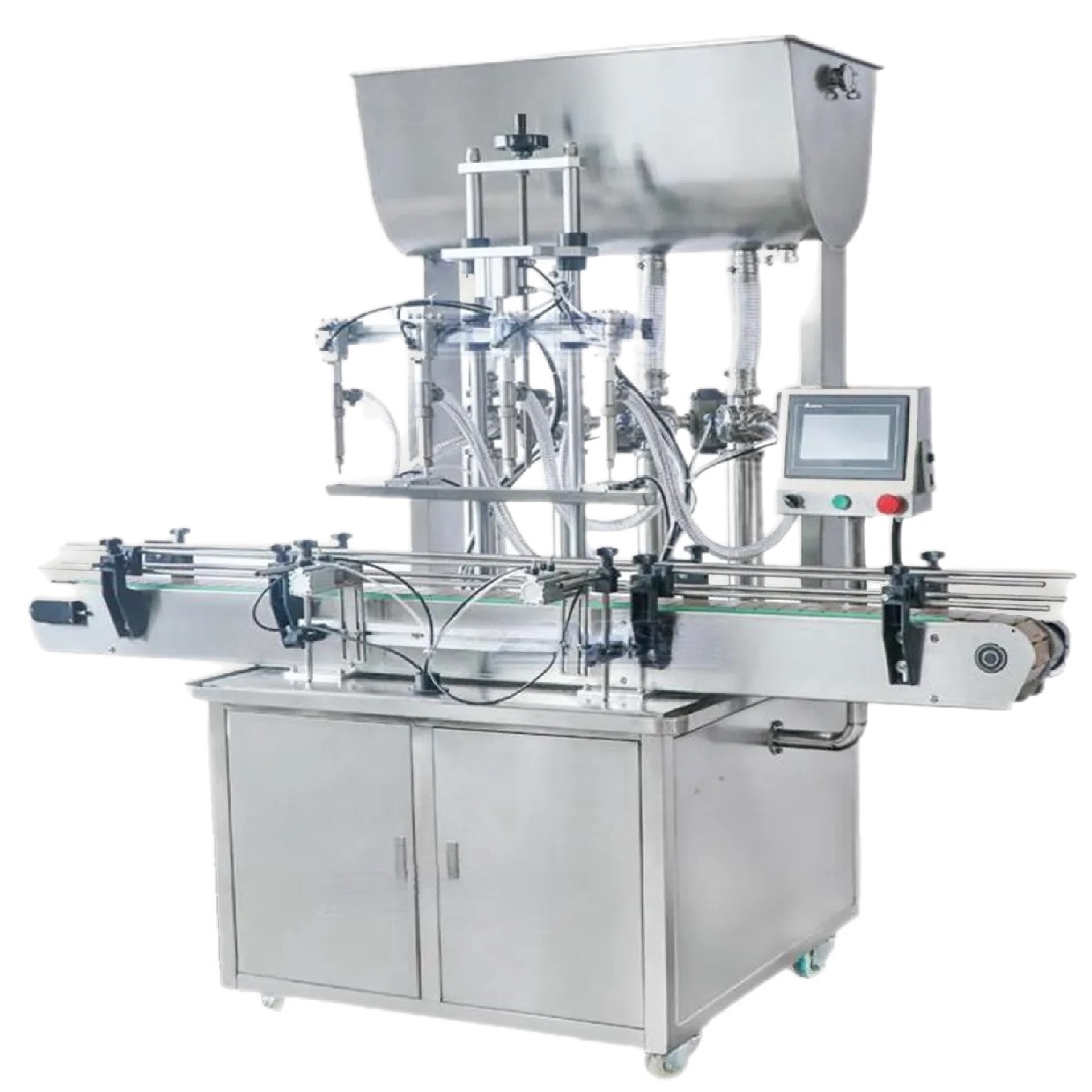
Model Automatic Volumetric 4-Nozzle
A compact four-nozzle automatic piston filler for repeatable volumetric dosing of viscous liquids and pastes. The machine route is commonly considered where a production line needs clean cut-off, recipe-based volume control and straightforward integration with conveyors, capping and labelling.
Published figures are application-dependent reference data and must be confirmed during specification or product trials.
Typical duties
Machine format
Reference specification
| Filling heads | 4 |
|---|---|
| Filling modules | 5–100 / 10–300 / 50–500 / 100–1000 / 500–3000 / 1000–5000 ml |
| Control | HMI with numeric volume entry |
| Nozzles | Anti-drip configuration |
| Container control | Bottle detection for automatic cycling |
Selection note
Confirm the actual product viscosity, temperature, particle content and container neck opening before choosing a cylinder module. Output also depends on fill volume, nozzle diameter, product feed and downstream line balance.
Prepare the project dataRelated machine families
Compare volumetric filling machines using piston, pump or cup dosing for liquids, pastes, sauces, creams and granules. UK advice from Lancing Ltd.
See optionsCompare piston, servo and rotor-pump paste filling machines for sauces, honey, creams, gels, adhesives and other viscous products in the UK.
See optionsAutomatic filling machines for liquid, paste, powder and specialist applications. Compare multi-head fillers, conveyors, controls and line integration.
See optionsQuick answers
The machine is normally shortlisted for honey, syrups and sauces, creams, lotions and gels, food pastes and condiments. Final suitability depends on product behaviour, materials compatibility, fill range and the intended container.
No. Published figures are reference conditions. Real throughput depends on product viscosity or flow, dose size, container handling, operator workflow, changeovers and downstream equipment.
Integration can be assessed with conveyors, container handling, capping, labelling, coding, sealing and accumulation. The control and layout scope should be agreed before order.
Send the product data, fill volumes, container samples or drawings, target output, utilities, cleaning method, available footprint and details of any upstream or downstream machinery.
Ready to discuss your application?
Tell us what you fill, your fill range, container and target output. We will help you narrow the practical machine options before quotation.
Application verification
The machine family should be trialled with the real product and each required container. A four-nozzle layout adds head-to-head comparison, common-feed stability and container-pitch questions that are not visible in a single-container demonstration.
| Verification area | Evidence to collect | Decision supported |
|---|---|---|
| Product feed | Hopper or bulk-feed condition, temperature, refill and air ingress during a representative run. | Whether all heads remain supplied consistently. |
| Head balance | Sequential results identified by nozzle at minimum, normal and maximum dose. | Whether settings or components need head-specific attention. |
| Nozzle and pack | Opening clearance, support, cut-off, neck cleanliness and release. | Nozzle geometry and container-handling arrangement. |
| Line states | Starved, blocked, missing-container and restart behaviour. | Automatic control, tracking and reject logic. |
| Cleaning/change | Recovery, product-contact parts, recipe and first-off restart. | Operating labour and approved changeover method. |
Use the accuracy and repeatability guide for the head-by-head protocol, the container-handling guide for pitch and support, and the FAT/SAT guide to carry the approved result into project acceptance.